The presentation materials used in the closing workshop on 5 Feb 2013 were uploaded here.

Feb 5, 2013
Nov 9, 2012
A Workshop for sharing the progress of the Pilot Project was held on Nov. 1st, 2012.
Six months have passed since the Pilot Project for collecting e-waste in Penang Island was started on June 2nd, 2012. A workshop for sharing the progress of the Pilot Project and the data accumulated for these six months was held in Penang Island on November 1st, 2012.
The workshop was opened by Dato' Hassan Bin Mat, Director, Department of Environment Penang. He emphasized the importance of the proper management of e-wastes from households.

The next speaker was Mr. Foo Kok Beng, Senior Assistant Environmental Health Officer, of Municipal Council of Penang Island (MPPP). He introduced MPPP’s plan to upgrade their original e-waste collection system initiated in 2004 through the collaboration with DELL and PEWOG (Penang Environment Working Group). MPPP is starting a new e-waste collection system for all types of e-waste, while MPPP only collects personal computers under the original system started in 2004.
Also, he showed MPPP’s will to continue with the Pilot Project on their own with DOE Penang even after the E-waste Penang Project coordinated by Japan International Cooperation Agency (JICA), noting that the Project is ending next March.

Dato' Dr. Ong Hean Tee, Chairperson of PEWOG invited by Mr. Foo Kok Beng, promised to support MPPP by emphasizing the importance of a round-table meeting among all stakeholders.

Mr. Hideki Wada, JICA Expert of Penang E-waste Project, reported that the Pilot Project is going well so far by introducing some results of the data analysis. The cooperation rate of people is rather low: 10-20% for home electric appliances and 30% for mobile phones, due to the low awareness among the people. If the Pilot Project gains recognition by 100% of the people, the expected cooperation rates would go up to 20-40% for home electric appliances and to 60% for mobile phones, where the present recognition rate among the people is around 40%. The estimation will be updated with the future data of collected e-wastes.
By using these data, the “Willingness to be paid” model were developed and introduced as a practical planning tool. These formulas can tell us about appropriate prices of e-wastes so as to attain a certain cooperation rate, assuming that the major factor defining people’s discarding behaviors is “price”. If the price cannot be covered by the price shown by the full recovery facility, the gap might be borne by the social cost by introducing a new mechanism.

The workshop proceeded to the questions and discussions part after expectations for the Pilot Project were stated from the official supporters and the local participating retailers.
The participants mainly discussed two things. One was about who shall bear the social cost, and the other was about further necessary actions for proper e-waste management.
About the social cost allocation, a participant proposed that consumers can bear the cost if it is included in the prices of e-products, even though any subsidization from governmental sectors may be effective as a short-term measures. Mr. Wada showed his concern that any subsidization from the governmental agencies might spoil the market mechanism.
About the further necessary actions, involvement of the informal sector and regulation on import/export were pointed out.
The workshop was closed by the words of Mr. Wada: “The Pilot Project is just a baby. Please bring up this baby by your cooperation.”


Nov 1, 2012
Presentations of the Workshop on Nov. 1, 2012
The presentations presented in the Workshop on Nov. 1 can be downloaded here.
(The presentation from MPPP has been uploaded.)
(The presentation from MPPP has been uploaded.)
Oct 13, 2012
Pilot Project Progress will be reported in the next workshop.
A workshop for reporting the progress of the Pilot Project are being held in Penang on Nov. 1.
Please check here.
Please check here.
Sep 14, 2012
Training in Japan and Business Matching Seminar in Tokyo
Some members of the full recovery facilities in
charge of the pilot project came to Japan in a training program coordinated by
JICA. The purpose of the training program is to develop the e-waste dismantling
techniques. They visited some e-waste recycling factories and experienced how
to dismantle e-wastes from households. It is expected that this training will
contribute to open up a new perspective of the technology and the method of
processing e-wastes.
 |
| Practicing how to dismantle e-waste (at Panasonic Eco Technology Center Co., Ltd. (PETEC))(Photo provided by PETEC) |
In the training programs, “Business Matching Seminar” was held on 12 September, 2012 in JICA HQ Office, Tokyo, inviting Japanese private companies, academics and mass media. JICA and the JICA expert team explained the basic statistics of Malaysian economy, rules and regulations for recycling and the findings of the pilot project so far. The participants and the two full recovery facilities got to know each other toward future mutual business opportunities.

Jun 7, 2012
The Pilot Project was launched!
Since March, we prepared for the Pilot
Project for collecting e-wastes from households for recycling. We discussed the
concept in the Local Working Group, invited the local businesses, developed the
monitoring system, designed the paper media for advertisement and prepared the
opening events. Finally, we could start the Pilot Project on June 2. You can
visit http://www.facebook.com/ewaste.Penang
managed by the local businesses with the related organizations for the further
information.
In the Pilot Project, two home electric
appliance shops and two mobile phone shops are ready to collect e-wastes from
households. Home electric appliance shops are offering to take back the
e-wastes from households upon delivery of the purchased products, while it is a
good timing for mobile phone shops to offer the customer to recycle their
mobile phones in the shops upon purchase. The progress of the Pilot Project
will be reported soon.
Two series of events were held for
celebrating the launching.
On June 1, the opening workshop was held.
The Pilot Project was celebrated by the opening remarks from Mr. Masayuki
Hayashi, JICA Malaysia and Dr. Zulkifli Abdul Rahman, Deputy Director General
(Operation), DOE Putrajaya. Also, Deputy Consul-General, Consulate-General of
Japan in Penang attended for celebrating the Pilot Project commencement.
The local businesses who participated in
the Pilot Project expressed their expectations, after Mr. Hideki Wada explained
the concept of the Pilot Project.
.jpg)
.jpg)
On June 2, the opening outdoor event was
held. The VIPs in Penang, including Consul-General, Consulate-General of Japan
in Penang made the speeches. In the event site, nine companies and
organizations including EPSON, Dell and the local businesses opened the booths appealing
to the visitors about the importance of the environment. Also, the lucky draw
was given to the visitor for further attention. Three official supporters
including Toshiba provided their products for the lucky draw prizes.
.jpg)
.jpg)
Jun 1, 2012
Presentation in Pilot Project Worshop
The presentation in the Pilot Project Launching Workshop on June 1, 2012 can be downloaded here.
Mar 28, 2012
Two important meetings were launched in Kuala Lumpur and Penang.
After coming back to Malaysia from the study
tour in Japan, we proceeded to the next step, the planning stage by setting up
two meetings.
For designing the e-waste recycling policy,
a meeting named “Official Consultative Meeting” was set up. For designing the pilot project in Penang
Island, a local working group was set up by the state government.
On March 26, the first official consultative
meeting was held by inviting the EEE manufactures. DOE explained that
collection of e-waste from households is the focal issue and any regulations
with EPR policy might be necessary. DOE emphasized to listen from the
industrial side first and the consultative meeting was set up for this purpose.
The participants from the industrial side agreed to present any ideas and
opinions in the next consultative meeting.
In the previous week to the consultative
meeting, on March 23, the local working group in Penang Island was held chaired
by the state government. Some EEE retailers, hypermarket stores and mobile
phone service providers participated. The ideas on the pilot project were
introduced and discussed. They agreed to consider the possibilities to
participate in the pilot project and present in the next meeting.
The pilot project is being planned in
detail based on the ideas of any necessary policies.
 |
| Policy design was discussed in the official consultative meeting in Kuala Lumpur on March 26. |
 |
| The pilot project design was discussed in the local working group meeting in Penang Island on March 23. |
Mar 2, 2012
The study tour in Japan successfully ended.
The study tour for the counterparts was
held for 12 days between 18th Feb. and 29th.
They heard from the related Ministries and
industries to know the laws/regulations in Japan for e-waste recycling and also
visited some recycling factories.
Based on the knowledge on the
laws/regulations in Japan, we discussed possible regulations suitable for the
situations in Malaysia. Also, ideas for the pilot project starting in next June
tentatively were discussed based on the ideas for the future policies.
The Japanese experts are coming back to
Penang on 4th March to discuss with the counterparts further.
 |
| The team visited a partial recovery facility in Tokyo. |
 |
| The team discussed future possible policies based on the lessons learnt in the Japan tour. |
Jan 25, 2012
Idea sharing workshop was held.
A workshop to share ideas on what
collection system for e-waste from households is applicable was held in Penang
on 17 Jan. 2012.

Y. Bhg. Datin Paduka Che Asmah Ibrahim, Director
of Hazardous Substances Division of DOE Putrajaya opened the workshop with a
message that it is very important to listen from the industrial side first.

Mr. Hideki Wada, the team leader of JICA
expert team made a presentation first on the amount of e-waste and the current
e-waste flow. Also, he pointed out by showing the result of the questionnaire
survey to households that 1) the number of collection centers should be
increased, 2) it is convenient for households to have retailers take back old
equipment when new products are delivered, and 3) economic incentive for
e-waste collection should be added.

Mr. Xavier Sebastian, Municipal Council of
Penang Island, explained the conventional e-waste collection businesses from
households by showing the photographs.

Mr. Mohd Fitri Mohd Mokhtar, DOE Penang, reminded
us the functions of the partial recovery facilities and the full recovery
facilities under the current e-waste related policies.
---
Manufactures and full recovery companies were
expected to make presentations based on many experiences related to e-waste
collection.

Mr. Bu Fan, DELL, expressed very positive
opinions on behalf of manufactures and proposed the following ideas as “shared responsibilities
among stakeholders”.
- Involvement of conventional recyclers is very important.
- Multiple collection channels such as 1) take-in/trade-in by retailers, 2) voluntary collection by community groups and 3) municipal waste management services should be facilitated with contribution from manufactures.
- The characteristics of target products should be considered. The characteristics of home electric appliance and ICT (information and communication technology) products are different.

Mr. John Ashok, TES-AMM Malaysia, a full
recovery company, proposed an e-waste collection system by taking the China
model as an example.

After all presentations, the participants raised
many questions to the speakers for deeper understanding. The workshop for
sharing the ideas and opinions were closed successfully.
The participants left their ideas and
opinions inspired by the speakers in “Idea Sheets”, which are being arranged by
the expert team.
The project is proceeding to the next step.
Jan 17, 2012
Jan 11, 2012
The second workshop is being held on January 17, 2011.
We are now compiling the data obtained in the series of the studies to an e-waste flow.
The result will be delivered in the coming workshop as one of the basic information for discussing the pilot project.
Not only such data, to make the discussion more effective, we asked to some manufactures of electrical & electronic equipment to make presentations which include their ideas on what kind of systems are appropriate to collect e-waste from household. We could expect them some good ideas from their worldwide perspective and experiences.
Also, we asked some full-recovery recyclers to make such presentations. We are looking forward to hearing their ideas from the persons who know the local conditions very well.
The result will be delivered in the coming workshop as one of the basic information for discussing the pilot project.
Not only such data, to make the discussion more effective, we asked to some manufactures of electrical & electronic equipment to make presentations which include their ideas on what kind of systems are appropriate to collect e-waste from household. We could expect them some good ideas from their worldwide perspective and experiences.
Also, we asked some full-recovery recyclers to make such presentations. We are looking forward to hearing their ideas from the persons who know the local conditions very well.
Taskforce Meeting was held on 21 December 2011.
The 4th
Taskforce meeting was held in Penang Island on 21 December 2011 following the
last Taskforce meeting on December 5, 2011. The members of DOE Headquarters,
DOE Penang and MPPP discussed present e-waste flow based on some results from surveys,
targeting e-waste generators, recyclers, e-waste collection centres authorized
by MPPP and retailers, etc. The e-waste flow in Penang Island is being
described with quantities and traded prices.
We also
discussed that all relevant actors should share the current e-waste flow for
discussing appropriate e-waste collection systems in Penang Island. For this, the
Taskforce meeting decided to hold a workshop in Penang Island on January 17, 2012.
It is expected that all relevant actors share their opinions and discuss the
future e-waste collection system based on the current e-waste flow.


E-waste Flow Surveys are being finalized.
During the
past few months, we concentrated on two surveys for describing the e-waste flow
in Penang Island.
One is the
questionnaire survey to the e-waste generators including businesses, such as
hotels, restaurants and offices and another one is the interviews to the e-waste
recyclers including small recycling collectors and dealers.
In the
survey, the amount of e-waste, the dealing prices and the vintages of e-waste
for calculating the future amount of e-waste were studied and the data is now
being analyzed.


Nov 19, 2011
The first JCC was held.

2011 chaired by Ms. Datin Paduka Che Asmah Bt. Ibrahim, Director of
Hazardous Substances Division of DOE.
The role of JCC is:
- To approve the annual work plan of the Project,
- To review the overall progress and achievements of the Project,
- To examine major issues arising from or in connection with the Project,
- To work out the modification of activities depending on the necessity; and
- To discuss any other issue(s) pertinent to the smooth implication of
the Project.
Oct 27, 2011
Scenes from the kickoff seminar in Penang on 24th Oct. 2011
On 24th October 2011, the kickoff seminar in Penang was held and many stakeholders participated.
The seminar was opened by a representative from JICA Malaysia and Dato' Hassan Bin Mat, Director of DOE Penang.
Four speakers made presentations as below.
The seminar was opened by a representative from JICA Malaysia and Dato' Hassan Bin Mat, Director of DOE Penang.
Four speakers made presentations as below.
 |
| Mr. Khiruddin Mohd Idris, DOE HQ, explained the framework of the project in Penang. |
 |
| Mr. Abu Hassan Mid Zain, MPPP, explained the collection system for PCs initiated with DELL, Sunshine and a NGO PEWOG. |
 |
Professor Yoshifumi Fujii, Bunkyo University in Japan, explained 1) the EU countries are very active in disseminating the concept of EPR and other environmental concepts under the concept of "Reflexive Modernity". When considering the EPR policy, it is noted that the EPR does not necessarily mean that manufactures have to pay the recycling cost, the payer should be considered so that the total social cost is minimized. He encouraged the stakeholders by adding that he expects any dynamic social change by the project. |
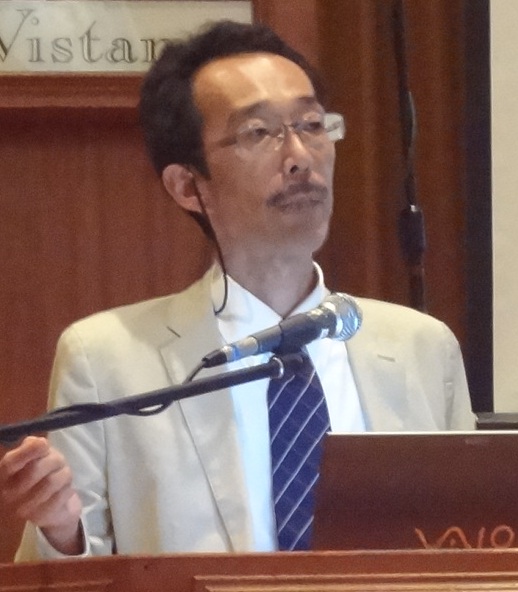 |
| Hideki Wada, the Team Leader of the Japanese Expert Team, emphasized that the Japanese e-waste related laws as they are cannot apply to Malaysia, after explaining the e-waste related laws in Japan. The differences of the background conditions between Japan and Malaysia should be considered. They are no more salable in Japan, while they can be sold in Malaysia. |
Oct 24, 2011
Presentations in the Kickoff Seminar in Penang
You can download the handouts of the presentation in the Kickoff Seminar In Penang here.
Oct 19, 2011
Small Recyclers in Penang Island
Yesterday, we visited small recyclers in Penang Island.
It is very convenient for households and individual collectors to bring the e-wastes to those small recyclers, located inside the town.
There, we could see some e-wastes. The e-wastes.are dismantled by the small recyclers and sent to larger dealers located in outside the town.
The structure is discovered gradually.
It is very convenient for households and individual collectors to bring the e-wastes to those small recyclers, located inside the town.
There, we could see some e-wastes. The e-wastes.are dismantled by the small recyclers and sent to larger dealers located in outside the town.
The structure is discovered gradually.
 |
| Refrigerator from a hotel |
Another expert came.
Another expert, Ms. Noriko Otsuki, arrived yesterday. She started working with us.
Oct 13, 2011
Program of the kickoff Seminar in Penang
As announced, we will have a kickoff seminar in Penang.
You can find the tentative program of it here.
You can find the tentative program of it here.
Subscribe to:
Posts (Atom)